



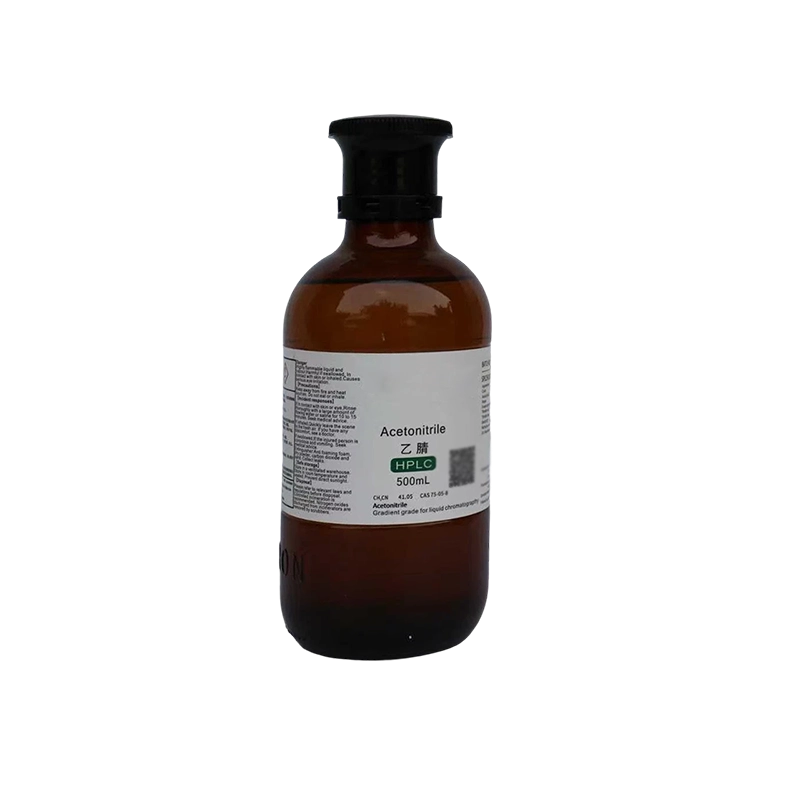
Acetonitrile is a volatile, clear, colorless liquid with a faint, ether-like odor. As the simplest organic nitrile, it possesses a high dielectric constant (epsilon ≈ 37.5) and strong dipole moment, making it an exceptional dipolar aprotic solvent. It is fully miscible with water, alcohols, esters, acetone, and chlorinated hydrocarbons, while showing minimal miscibility with saturated hydrocarbons.
Acetonitrile ACN / MeCN CAS 75-05-8
Description
- CAS: 75-05-8
- Synonyms: Methyl cyanide, Cyanomethane, Ethanenitrile, ACN, MeCN
- Einecs: 200-835-2
- Molecular Formula: C2H3N/CH3CN
- Grade: HPLC Grade / Spectro Grade / Industrial Grade / Reagent Grade
- Package: As required
Details
Chemical Reactions
- ydrolysis: Catalyzed by acids or bases, it hydrolyzes to form acetamide (CH₃CONH₂) and subsequently acetic acid (CH₃COOH).
- Reduction: Catalytic hydrogenation (e.g., over nickel or palladium) reduces acetonitrile to ethylamine (CH₃CH₂NH₂).
- Nucleophilic Addition: The electrophilic carbon in the -C≡N nitrile group reacts with nucleophiles (e.g., Grignard reagents) to yield ketones after hydrolysis.
- Coordination Chemistry: Functions as a versatile, weakly coordinating labile ligand in transition metal chemistry.
Specifications
| Appearance | Clear, colorless transparent liquid |
| Assay (Purity by GC) | ≥ 99.9% (HPLC Grade) / ≥ 99.5% (Industrial Grade) |
| Melting Point | -45.7℃ |
| Volatility | High (Boiling Point: 81.6℃; Vapor Pressure: 9.86kPa at 20℃ |
| Ash Content (Evaporation Residue) | ≤ 0.0005% |
| Solubility | Completely miscible with water, methanol, ethanol, ether, acetone, and chloroform |
| Thermal Stability | Stable under normal ambient temperatures; decomposes at extreme high temperatures to yield toxic hydrogen cyanide (HCN) and nitrogen oxides (NO) |
Applications
- Chromatography & Analytical Testing (HPLC / LC-MS): Functions as the primary organic mobile phase solvent. Its low UV-cutoff wavelength (190 nm), low viscosity, and strong elution capacity yield high column resolution and minimal backpressure.
- Pharmaceutical & Oligonucleotide Synthesis: Serves as a reaction and washing medium in peptide, API, and nucleic acid synthesis. Provides an anhydrous environment that prevents moisture-induced hydrolysis during phosphoramidite coupling steps.
- Lithium Battery Electrolytes: Functions as a co-solvent in lithium-ion battery electrolytes, reducing solution viscosity and enhancing ionic conductivity at low ambient temperatures.
- Agrochemicals & Fine Chemicals: Used as an active solvent and intermediate for synthesizing pesticides, insecticides, and synthetic pharmaceuticals like Vitamin B₁.
Storage Requirements
- Environment: Store in a dry, cool, well-ventilated flammable liquid storage facility at temperatures between 15°C and 25°C (59°F to 77°F).
- Safety Isolation: Keep strictly away from heat sources, open flames, sparks, direct sunlight, and incompatible materials (strong oxidizers, acids, and bases).
- Sealing: Keep containers tightly closed. Ultra-dry/HPLC grades should be kept under an inert dry nitrogen blanket to avoid atmospheric moisture absorption.
Handling & Usage Precautions
- Ventilation & PPE: Always operate within a fume hood or equipped local exhaust system. Wear chemical splash goggles, butyl or nitrile rubber gloves, and flame-retardant anti-static clothing.
- Static Safety: Ground and bond all metal containers and transfer lines during bulk pouring to prevent electrostatic ignition.
- Toxicity Hazards: Toxic if swallowed, inhaled, or absorbed through the skin (metabolized into cyanide in vivo). Avoid contact with eyes, skin, and apparel. Maintain immediate emergency washing stations nearby.
Common Formulations & Roles
- HPLC Mobile Phase Blend:Acts as an organic modifier to optimize chromatographic retention times, suppress peak tailing, and promote protonation during mass spectrometry electrospray ionization (ESI).
- Oligonucleotide Coupling Solution:Delivers an ultra-dry reaction vehicle (< 10 ppm water) ensuring maximum activation of phosphoramidites without premature reagent degradation.
- Low-Temperature Electrolyte Formulation:Reduces total solution viscosity to enable rapid lithium-ion mobility in sub-zero environments.
Packaging Method
Fiber drum or carton box, lined with PE bag. Customized packaging available upon request.
FAQ
-
Q: How to get more information about the product?A: You can contact us via email at info@zhpmchem.com or WhatsApp at +8618321309391 for more information about our products and company.
-
Q: Does the product meet our requirements regarding formulation, equipment, and processing?A: Yes, we will adjust the product formulation to your specific needs, ensuring it meets your processing requirements.