



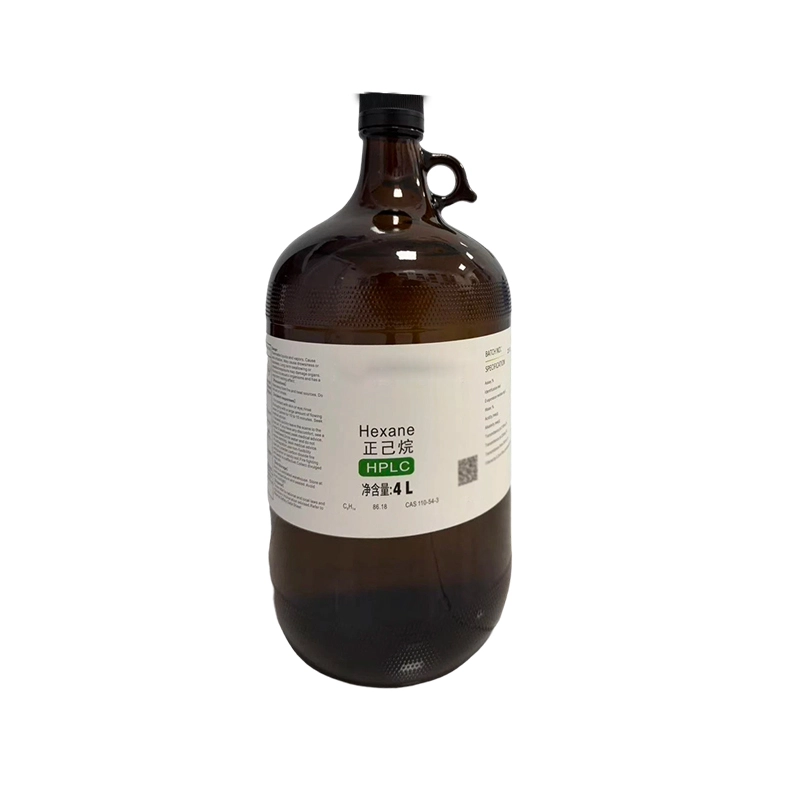
Introduction
n-Hexane is a straight-chain alkane. It is a colorless, highly volatile, and extremely flammable liquid with a faint, characteristic odor. It is a typical non-polar solvent with extremely stable chemical properties (it does not react with acids, alkalis, or strong oxidants at room temperature). It is extremely insoluble in water but can be mixed in any proportion with other non-polar organic solvents (like chloroform and ether).
Specification
| Item | Specification |
| Appearance | Colorless, transparent, highly mobile liquid |
| Assay (Purity) | ≥ 99.0% |
| Melting Point | -95 °C |
| Volatility | Extremely Volatile (Vapor pressure 17 kPa at 20°C) |
| Ash Content | ≤ 0.001% |
| Solubility | Insoluble in water, miscible with organic solvents |
| Thermal Stability | Highly stable, flammable (Boiling point 69°C) |
Applications and Functions
- Vegetable Oil Extraction: The most important extraction solvent in the grain and oil industry, used to extract edible oils from seeds like soybeans and peanuts.
- Chemical Solvent: An excellent inert reaction solvent in rubber synthesis and polyolefin polymerization processes.
- Cleaning & Degreasing: A powerful degreaser in the electronics industry and precision machining, used to remove glue residue and mechanical oil from components.
Storage Requirements
It is an extremely flammable liquid with a flash point of only -22°C. Must be stored in a cool, well-ventilated, Class A hazardous materials warehouse equipped with explosion-proof electrical equipment. Keep away from fire, heat sources, and oxidants. In summer, precautions must be taken to prevent high temperatures from causing a sudden increase in internal container pressure.
Handling and Precautions
Open flames and static electricity accumulation are strictly prohibited (grounding is required during filling and pouring). n-Hexane possesses chronic neurotoxicity; prolonged inhalation of low-concentration vapors can lead to peripheral neuropathy (such as numbness and weakness in the limbs). The operating area must have a powerful local exhaust ventilation system, and operators must wear gas masks.
Formula & Function
Soybean Oil Industrial Extraction: Flaked Soybeans + Large amounts of n-Hexane.
Function: n-Hexane is an excellent non-polar solvent, following the “like dissolves like” principle with the fats in soybeans (which are also non-polar). It easily penetrates cell walls to completely dissolve and extract the oil. After extraction, leveraging n-hexane’s low boiling point (69°C), the solvent is volatilized and recovered through gentle distillation, leaving behind pure crude oil.
Packaging
fiber drum or carton box, lined with PE bag. Customized packaging available upon request. (Note: Highly flammable liquids are conventionally in steel drums/isotanks).