


Introduction
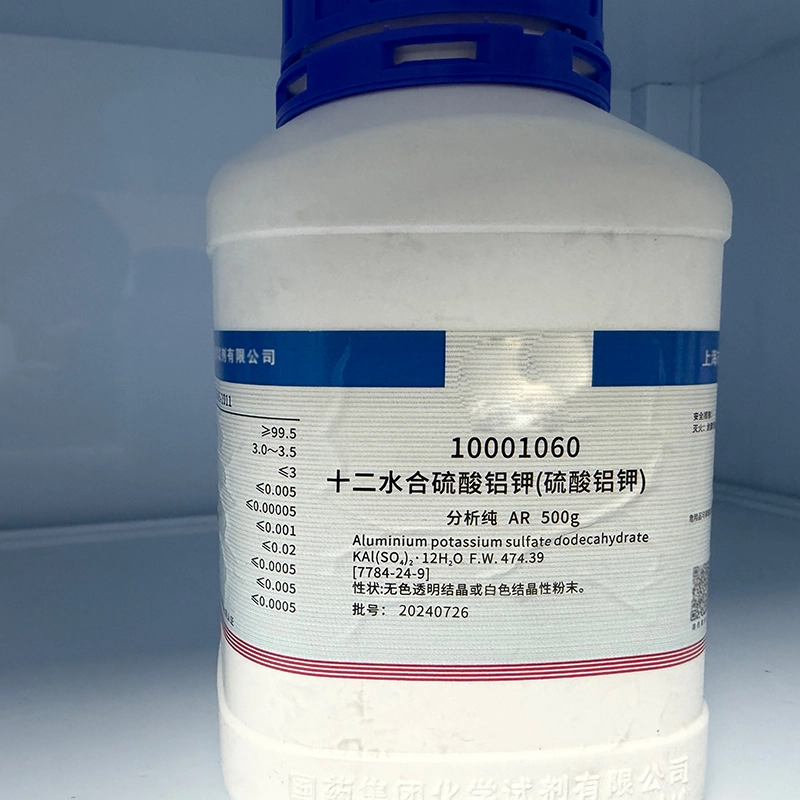
Potassium aluminum sulfate dodecahydrate, commonly known as alum, is a double salt of potassium and aluminum containing water of crystallization. It appears as colorless transparent blocky crystals or white powder, tasting slightly sweet and astringent. Its aqueous solution is acidic. In water, aluminum ions hydrolyze to form colloidal aluminum hydroxide flocculant precipitates. Heating to 92°C loses nine water molecules, and continued heating produces white powdery “burnt alum” (anhydrous alum).
Specification
| Item | Specification |
| Appearance | Colorless transparent crystals or white powder |
| Assay (Purity) | ≥ 99.0% |
| Melting Point | 92.5 °C (Loses water of crystallization) |
| Volatility | Non-volatile |
| Ash Content | Leaves K2SO4 and Al2O3 upon calcination |
| Solubility | 14 g/100 mL (20°C in water), insoluble in alcohol |
| Thermal Stability | Loses crystal water upon heating, forms anhydrous “burnt alum” |
Applications
- Water Treatment: A traditional water purifying agent that forms aluminum hydroxide colloids to adsorb and settle suspended impurities in water.
- Food Processing: Used as a leavening and firming agent in traditional fried dough sticks (youtiao) and vermicelli (Note: usage is now restricted in the food industry due to aluminum residue concerns).
- Dyeing & Papermaking: Acts as a mordant to fix dyes to fibers; used as a precipitant for rosin sizing in papermaking to enhance paper water resistance.
Storage Requirements
Store in a cool, dry, and well-ventilated warehouse. Packaging should be sealed to prevent caking from moisture or efflorescence (loss of water). Store separately from toxic or alkaline substances.
Handling and Precautions
It is non-toxic, but long-term or excessive ingestion of aluminum ions is harmful to the human body (especially the nervous system). Avoid packaging damage during handling. Wear dust masks when handling the powder to avoid massive inhalation.
Formula & Function
Traditional Water Purification: Turbid Pond Water + Alum (approx. 50-100 mg/L).
Function: After dissolving in water, the aluminum ions (Al3+) in alum hydrolyze to form positively charged aluminum hydroxide [Al(OH)3] colloids. These colloids not only neutralize negatively charged mud and sand particles but also trap and adsorb them, gathering them into large flocculent particles that settle to the bottom, thereby clarifying the water.
Packaging
fiber drum or carton box, lined with PE bag. Customized packaging available upon request.